Sunday, October 17, 2010

Recreation of an Old Master in Tempera

For my current art class assignment I had to choose a 15th century tempera painting and do my best to copy it. My choice is this portrait by Ghirlandaio from the late 15th century.


I printed a full size copy of the original, then used tracing paper to get a cartoon of the major lines. I colored on the back of the cartoon to make the cartoon function as transfer paper, then traced the lines of the cartoon onto my board. My board is tempered Masonite which I chose because I could not find untempered Masonite that was smooth on both sides. Everything I've read says untempered is better because tempered Masonite is tempered with oil but we'll see what happens.


I roughed up the Masonite with sandpaper then applied a coat of warm rabbit skin glue. After that dried I applied several coats of warm gesso made with chalk and rabbit skin glue. Once the gesso dried overnight I sanded the board smooth.

Once the drawing was on the gesso I used non-waterproof black ink to make a value drawing. I used non-waterproof so I could correct mistakes easily. I sealed the finished grisaille with a light coating of egg yolk and water mixture so the ink would not be lifted by succeeding coats of tempera.

Next I started working in color, using verona green earth for skin, and yellow ochre and umber for clothing and hair. In this picture I have started the skin and hair but not the clothing. The white chemise has undertones of other colors so I started with a darker color.


The clothing in the finished painting is green but has a definite yellow cast which is why I chose to start with ochre. This picture also shows that I started to color the necklace.


Here I have been focusing on the clothing. I decided to leave the face to last as working on the rest of the painting will give me practice handling the paint so I will be "warmed up" when I get to the face. I am still going to work on this some more because I am not completely happy with the green. On top of the yellow ochre and umber underpainting I used celadonite and lead white to render the green cloth. Then it wasn't yellow enough so I mixed another set of greens using celadonite, lead white and Naples yellow with almost pure white and yellow for the highlights. This is better, but still not quite what I was going for. Unfortunately I did not take pictures of the different layers so I don't have the progress to show. This last picture shows where I am with the painting as of this evening. I reached a point where I was only making it worse by continuing to work on it so I decided to take a break until tomorrow.

Also note that in this picture the necklace and white chemise are more finished.

Thursday, September 30, 2010

Spam, blech

I find the word verification feature for commenting kind of annoying when I comment, so I removed the requirement from my blog. Less than 24 hours later I received 4 spam comments! So, I put it back, sorry. I hate spammers.

Sunday, September 19, 2010

Painting with fresco


I enrolled in this great class at a local college called "Aesthetics and Techniques of the Old Masters". It is an interesting hybrid of art history and art technique focusing on Europe (mostly Italy) from 1300 to 1600. The purpose of the class is to expose students to traditional painting methods and materials of fresco, tempera, and oil painting which includes making our own boards for painting and grinding our own paints. The idea of painting in fresco really intrigued me, as did the idea of learning techniques in tempera beyond those used for iconography.

The fresco painting experience was paired with learning about art of the 14th century. Each student had to choose something from a fresco of that century and attempt to reproduce in. Due to time constraints and some prior bad experiences with cracking that the instructor had using metal lath, our frescoes were painted on unglazed saltillo paving tiles.


My choice was the face of an angel from "The Last Judgement", painted in 1300 by the Roman artist Pietro Cavallini. Fresco has its own unique challenges: you can only work in small sections, and you can only work on the painting once because once the plaster starts to dry it will no longer bond with the paint. Also, because of the alkaline lime in the plaster, many colors are not compatible so you mostly have to use earth colors. The technique is more like painting watercolor: work from light to dark, leave unpainted areas for white. I've never been a watercolor painter but I tried and it was fun. Next week I get to see if my plaster dried without cracking. All in all, it was a fun experience but I think I'll stick with tempera. At least it gives me an appreciation of why frescoes look the way they do and what limitations artists worked with which affected their choices in executing frescoes.

Thursday, August 26, 2010

A 14th century purse in fresco


As if I needed any more evidence that I need to learn Turk's head knots, here is an image of a purse trimmed with them from the fresco Allegories of the Virtues and Vices painted by Giotto in 1303-5. This detail depicts Invidia (envy). For further information about this fresco please see the book mentioned in my last post.

Tuesday, August 24, 2010

Image of a plane in the 14th century

I came across this today while searching for something else. It's a painting of a hand plane from the 14th century. That is the earliest depiction of a hand plane I have seen; I'm not sure how long hand planes have been in use but I'd guess much earlier than this. However it is always good to have evidence.


Admittedly, my knowledge of tools in history is pretty limited, as is my knowledge of the ancient Roman philosophy that influences the subject matter in this painting. This image, a detail of the fresco Allegories of Good and Bad Government painted by Ambrogio Lorenzetti in 1338-9, shows a woman holding a hand plane. If I find any earlier images I'll have to take note. For more details about this subject and lots of images of this and other frescoes, please see the marvelous book: Italian Frescoes, the age of Giotto, 1280-1400 by Joachim Poeschke ISBN-13: 978-0-7892-0863-7.

Friday, July 2, 2010

How to make gold paint


There are lots of imitations out there, and some come close, but nothing beats the look of real gold paint. It adds a level of richness to any painting. It shines beautifully. It can be burnished for more shine.

It is possible to buy ready made gold paint from art suppliers. I've never used it, but those who have used store-bought and home made gold paint say there is no comparison. It is not hard to make, either. Just tedious!

This little photo essay explains the basics of making gold paint. Sorry about the bad photography, it is not one of my talents. The how-to is a compressed .JPG file, I do have a larger file on my hard drive.

Tuesday, June 29, 2010

Making egg tempera

When I first became interested in learning to paint with egg tempera I was a bit intimidated by the actual process of making the paint. Here is a simple way to make the tempera that is mixed with powder pigments to make paint:

Mix two parts dry white wine (less sugar) with one part egg yolk. That's it!

This mixture will last several days, keeping in the fridge when not in use. Egg yolk should be pierced with a knife and drained from the yolk sac; don't just mix the whole yolk into the mixture. Optionally run the finished mixture through a strainer to get out any stray yolk sac bits that will result in clumps in your paint.

Here's a simple visual:


There are other recipes for making tempera, but this is what I learned from the Prosopon school of Iconography. Other examples of recipes are just to use egg and water, egg and water with clove oil, or egg and water and vinegar. You decide.

Thursday, June 24, 2010

Continuing the Icon: 2nd highlights

Now the second highlights are painted on Mary's robes using hematite, carmine and lead white. Jesus's robes will be highlighted with shell gold so they will not have any other highlights:


Faces are floated with a translucent gold ochre, carmine and Venetian red mixture, Mary's robes are floated with carmine red and indanthrone blue(a nice Bing cherry color) which really toned down the second highlights. Second highlights were repeated with a lilac color made from carmine, indanthrone blue and lead white. Flesh highlights were supposed to be lead tin yellow but I didn't have this so I used Naples yellow light mixed with lead white:

Wednesday, June 23, 2010

A brief word about toxic colors

Some of the colors I use in my painting are very bad for you. Lead white, Naples yellow, lead tin yellow, and minium are all made from lead. Chromium green oxide is toxic, as is the copper carbonate in azurite, and there are many other examples. Further, all dry pigments can basically be a lung irritant if inhaled. If you are going to use dry pigments, especially the more toxic/poisonous ones, follow some basic precautions:

1) Prepare paints in a breeze-free area. The last thing you want is a gust of wind swirling up and dispersing your lead white just when you have the jar open.

2) Wash hands after painting, and change clothes or wear a smock.

3) No food, drink, or putting anything in your mouth while working.

4) Clean up work area when finished.

5) Store pigments carefully, out of reach of children, pets, and the curiously unwary (these can be adults).

There are lots of web resources for information about working with hazardous materials, as well as additional safety gear such as appropriate masks, etc.

There are also work arounds that may may not not yield as beautiful or traditionally authentic results but are safer. One example is to mix Titanium white and Zinc white in place of lead white. Titanium white by itself is a too opaque and zinc white too transparent, but mixing them is a nice compromise.

Tuesday, June 22, 2010

Next step in the icon - highlighting with dark color

Here are flesh areas only with first highlight color (indigo):


Here is first highlight painted on Mary's robes (Venetian red) as well as second highlight started on the flesh areas (Venetian red, carmine, lead white):


The workshop I attended focused on development of more advanced painting techniques and varies from what is taught to beginners. Beginners are taught a specific, easy to follow order of painting: roshkrish, 1st highlights, 1st float, 2nd highlights, 2nd float, 3rd highlights, etc. This week we learned to mix up the order a bit. First and second highlights were painted and then floated, then second and third highlights painted followed by another float. The order was determined by the needs of the painting, using a more intuitive approach rather than a rigid formula. This was both challenging and frustrating because I was so looking forward to the first float (because it mellows out the harsh colors of roshkrish and first highlight) but I had to wait!

Another difference in the more advanced technique was the use of dark colors for the first highlights (more like "darklights", I think). This method seperates dark areas from light and builds volume. I used Venetian red for Mary's robe and indigo blue for the flesh.

Sunday, June 20, 2010

Continuing the Icon: Roshkrish (base color)


In icon painting, paint is laid down from dark to light, from coarse grain to fine. Here is the base color, roshkrish, over the entire icon. The flesh is painted with a mixture called sankir which is a greenish brown. Mary's garments are robes in vermillion and carmine and sleeve/head covering in indigo and indian yellow, and Jesus's robes are minium.

The lines of the drawing were painted with black before the colors were painted and you can see that they still show through. This layer, like pretty much every layer of paint in this technique, is painted transparently. In fact, my colors are almost too opaque. Better to paint too transparently and have to repeat the layer than to paint a single thick layer. In the end this will result in colors that are deeper and more nuanced than solid layers of color.

Tuesday, June 15, 2010

Icon Step 1a - Incising the lines


Next, the lines of the drawing are incised into the gesso. This will provide a guide for general shapes and details. The incised lines will still be visible after the base color is painted, while the colored lines will not. This photo shows the icon board in a raking light so it is possible to see where the lines are incised. Use the smaller side of double-sided stylus or something similarly small, round and metal. Gesso is hard, it takes significant pressure to make the lines. The lines should be pressed into the gesso, not cutting through it (that's why you shouldn't use a sharp blade instead of a stylus).

Sunday, June 13, 2010

Gilding after beginner's luck; saved by vodka


The first time I gilded on clay bole it turned out absolutely fantastic, unfortunately this gave me a false sense of ability. Now I am learning the hard way what can go wrong with gilding. What should have taken me about 6 - 8 hours ended up taking twenty and it isn't as pretty as I hoped it would be but it is done.

The first time I gilded an icon with clay bole I used bole my instructor made herself. I tried to use her recipe to make my own bole but it turned out horribly every time and I'm still not sure what I did wrong.

To prepare my icon I decided to take no chances and use professionally prepared bole instead of my own concoction. With the prepared bole you have to add a bit of honey so the gold will stick. I added too much honey and ended up with a gooey mess that wouldn't dry. I ended up having to scrape it off with a razor blade, making my gesso surface uneven. Then I was so traumatized that I did the bole for the background with no honey added. It dried like it was supposed to, and the gold seemed to go on, but the slightest touch would rub the gold away. Yikes!

Then I seemed to get the proportion about right and laid the bole for the halos but kept accidentally getting a finger or arm stuck in it. Also I accidentally dropped a loose gold leaf on it before it was dry - what a mess. After hours of sanding and angry thoughts too incoherent to form swear words I finally ended up with halos that would accept gold and a background that would not. What to do?

To solve the problem of the background I turned to water gilding, a technique I learned years ago but hadn't practiced since. Instead of laying down the leaf on the bole with just the moisture of a breath to make it stick, with water gilding you moisten the surface to be gilded with a solution of alcohol and water. The website I was referencing recommended using water with alcohol added, but I remembered what I learned from Russian icon painters and used what they do: cheap vodka. Vodka already has water and alcohol mixed together, and it worked perfectly. My background area is supposed to be matte so I did not have to worry about not being able to burnish the area. The only difficulty with water gilding is that the gold will stick to everything, unlike regular bole gilding where the gold only sticks to the clay.

In this photo you can see where I just started water gilding. The solid gold areas were laid down with vodka, the patchy areas were where the gold rubbed off because it wouldn't stick to the clay by itself.


Thursday, June 10, 2010

Starting a new icon, Step 1


I will be spending all of next week at an icon workshop, painting a Prosopon style icon. For those who have been reading my blog for a while you may remember the icon of St. John the Forerunner I painted at the workshop last year. That was my second icon, but the first in the Prosopon style; it was a beginner level composition. This year's subject is an intermediate level composition with lots of gold (you'll see!). With such a large area of gold it will be EXTREMELY important how well I lay down the bole. I am a little nervous about that. All the gold is supposed to be finished by the time I get to the workshop on Sunday so I'll post pictures up to that point. I won't have internet access during the workshop (and I don't really want it - it will be nice to get away) but I will take lots of pictures and post a step-by-step photo essay when I return.

The 13 by 17 inch icon board is purchased; I just didn't have time to teach myself to make a solid wood board with braces before the class. Eventually I plan to do that; I've only made it as far as cutting wood so far.

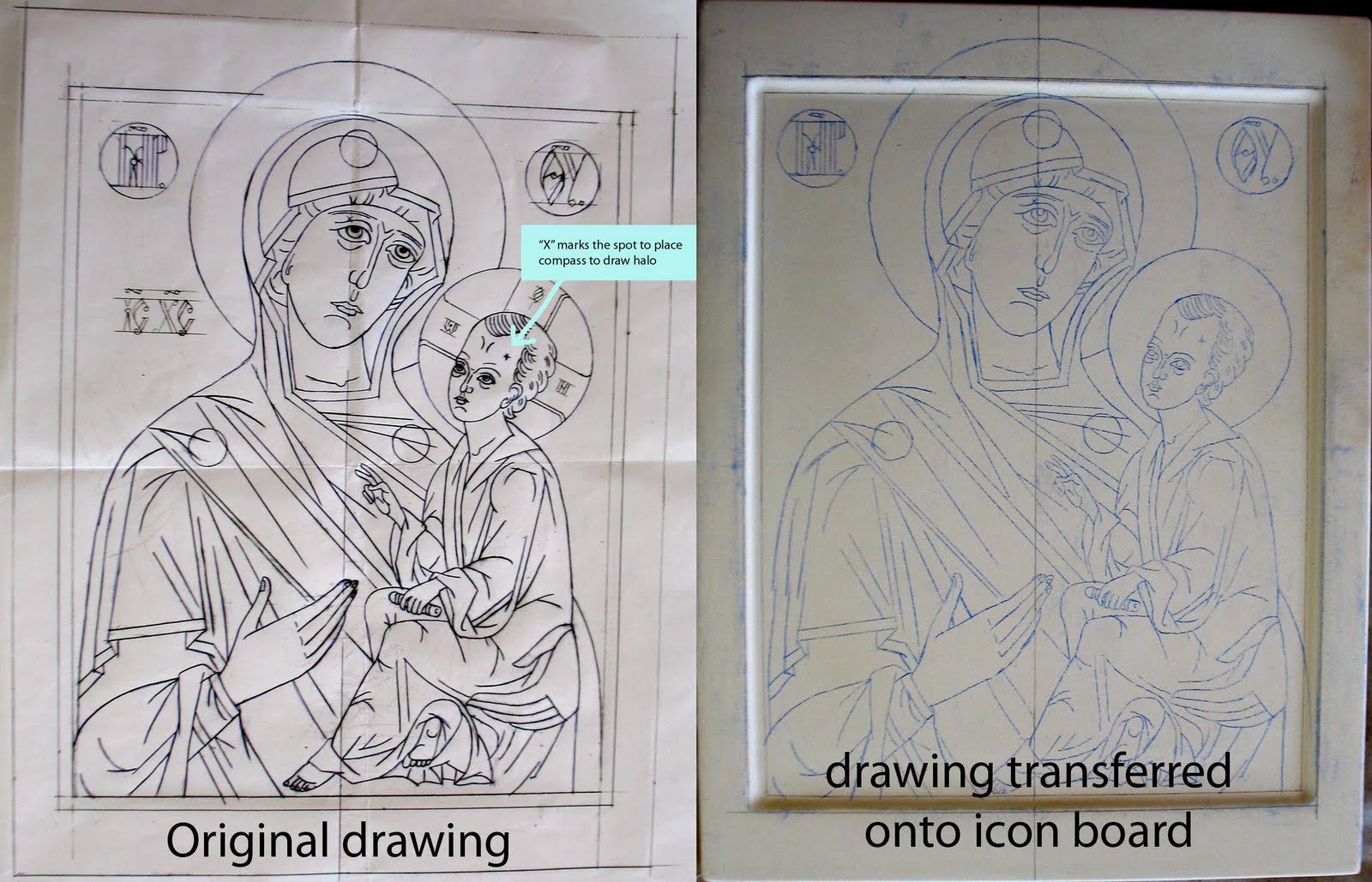
The drawing was made by the instructor, Dmitri Andrejev, following rules of composition about which I am largely ignorant. I wouldn't want to try drawing my own composition - if I were trying to authentically follow the style - without greater knowledge. There are specific ways hands, faces, etc are drawn that have specific meaning.

The drawing is then transferred to the board. First, draw a center line down the middle of the board, just like in the drawing. This will ensure the drawing is not transferred out of alignment. I used transfer paper and a ball point pen to transfer the drawing. Note that there is a little "x" on the face of each figure. This is to mark where to place the compass that is used for drawing the halo.

Monday, April 26, 2010

Slow work takes time


I realized that I haven't posted in a month! Still no workshop access, so not much going on in the woodworking department. Still raining off and on here, so no reliable working outside, alas. Meanwhile I keep plugging away on this cushion. It is slow going, and slow work takes time. The picture shows about 2/3 of it, I'm doing the pattern now and will fill it all in when that is done.

Thursday, March 25, 2010

A medieval waxed tablet

With much gratitude to the waxed tablet links on Larsdatter.com I conducted some research into making a waxed tablet. There are variations in the number of leaves in the tablets; I chose to use the fewest number, two, because the end result would be less bulky and also easier to construct.

I chose quarter sawn white oak as it is the most similar to European oak commonly used in the period, has pretty grain, and because it is quarter sawn is more stable and less likely to warp.

Different colors were used to mix with the beeswax in extant tablets including black, red, and yellow. I decided on red because I had a large amount of the pigment, thought it would look good, and work well enough when written upon.


The linseed oil and wax finish is a period appropriate finish and looks very good. This was my first time using linseed oil and I was extremely pleased with the result. The oil really brought out the beauty of the wood grain. I am now completely sold on using it in a finish and looking forward to trying it under shellac. Here's what it looks like in full sunlight:


Here is a little photo essay showing my process and progress to date:

Monday, March 22, 2010

Brick Stitch Pattern #20


It's been too long since I made a new pattern! This pattern is my 20th, bringing me 40% of the way to my goal of 50 patterns for the A&S 50 Challenge.

Once again, the source of the pattern is a German religious wall hanging. This one is dated to both 1290/1300 and the mid 14th century. Here is the detail I used:


Since the photo is black and white and I have never seen the original I have to invent the colors. I played with using a different number of colors. Maybe you can get an idea of a way to put them together with other patterns (the way the three colored motifs are stitched together below is a hint)?

Thursday, March 18, 2010

Brick stitch cushion


Stymied by my long wait for the yellow thread I ordered to finish my embroidered box project, I decided to start something else. I am getting quite a collection of brick stitched articles, but they are all purses, needle books or needle rolls. They are also all silk and must be cared for carefully. Therefore I am going in a different direction and making something designed for harder use, which is why I chose wool for my thread. It is a cushion designed to be placed on my new bench.

For the pattern I am not copying one specific extant piece, rather I am using elements from various pieces.

Monday, March 15, 2010

Oak bench finished (well, just about)


Here is my new bench in all its glory. It is patterned after numerous 16th century examples of benches. It is made from flatsawn white oak (because I couldn't find quartersawn of sufficient width where I live), fumed with ammonia, shellacked with 3 coats blonde and 3 coats orange shellac. I may put a final coat of varnish, or just wax it, I haven't decided.

The color isn't what my original goal was, but I like it well enough. I didn't think to use linseed oil before shellac, but tried it after on another project and it really made a difference. I think all future projects will have linseed oil before shellac. The shellac went on so smoothly and beautifully, it hardly needed any smoothing when I was done. I enjoyed using the shellac and the easy cleanup, I can see myself using this almost exclusively in the future.

The use of shellac is not period so it is not a true medieval finish, but I will be using this piece in my house and I wanted something that didn't have much upkeep. Also I am a novice woodworker and finisher and every project I plan is to build up my skill set so I can make furniture for my home.

Wednesday, March 3, 2010

Needle roll from Pattern #8


I'd like to teach another brick stitch class, and to that end am planning on stitching more of the patterns I made. Eventually I would like to have examples of all of them. This little pattern was easy to stitch and the needle roll is small and quick to make.

The finished size is 3 inches long and 2 1/4 inches high. The embroidery took between 5 and 6 hours, with another 2 or 3 hours to weave the cord and sew everything together. Materials were 28 count linen, and single strand Aurora Silk in undyed (white), indigo, and cochineal (purple) dyed by my friend Renee of Solar Colors and a green of a similar silk thread from the store.

As much as I liked making this, I can only have so many needle rolls. Some of the other patterns will be made into purses and other things.